'%20stroke-width='82'%20stroke-linecap='round'%20stroke-linejoin='round'%20/%3e%3cpath%20d='M%20345%20200%20L%20360%20130%20L%20405%20200%20Z'%20fill='url(%23zenboost-gradient)'%20/%3e%3c/svg%3e) Zenboost
ZenboostWhen Capacity Limits Agency Growth: The Real B2B Ceiling
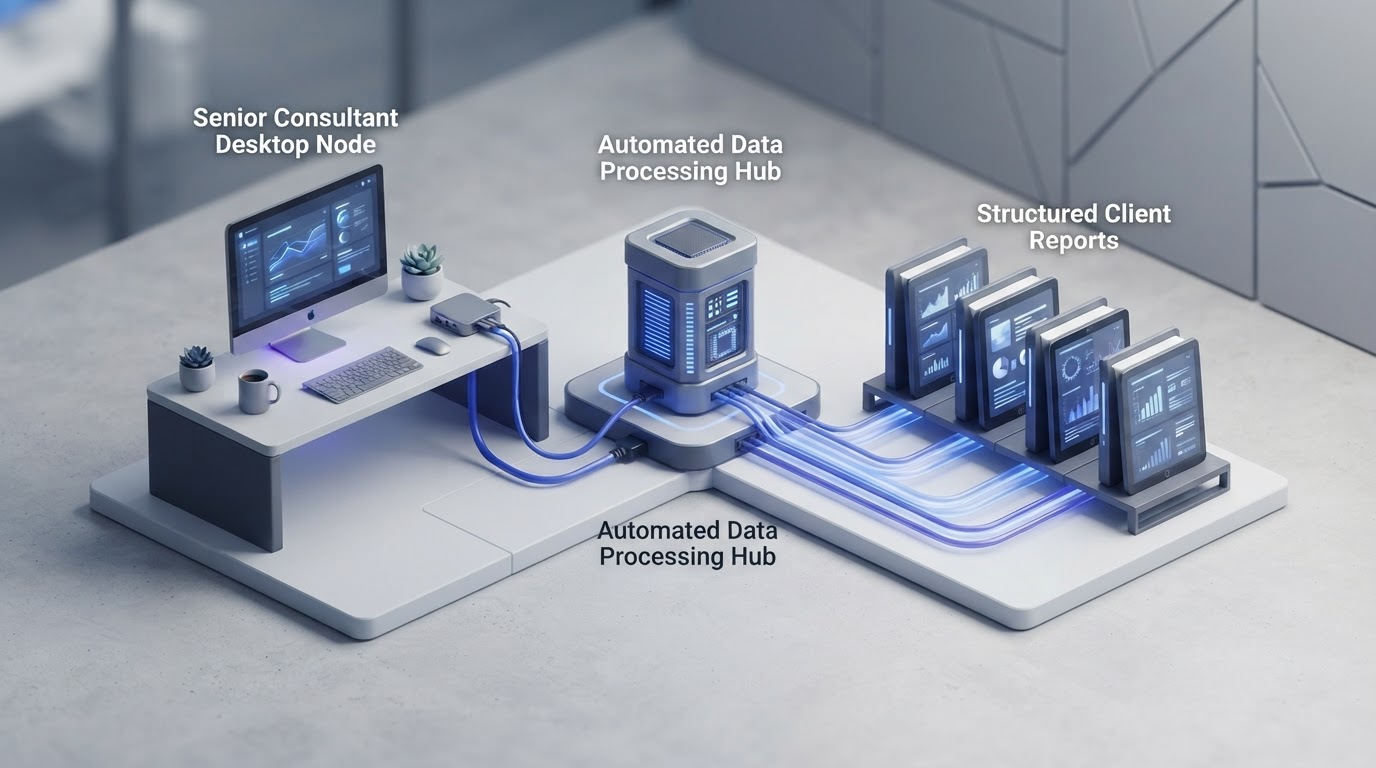
Turning down a qualified client due to a lack of execution capacity is rarely a sign of market shrinkage; rather, it highlights a structural bottleneck in delivery and founder dependency. When agency growth plateaus, business leaders must distinguish between true delivery constraints and pricing misalignments. By automating preliminary framing and diagnostic audits, firms expand operational throughput without expanding headcount, preserving profit margins while capturing pent-up market demand.
The Agency Capacity Ceiling: Execution Over Demand
Saying no to a prospective client hits with a cold, mathematical clarity. It is not the vague anxiety of an empty pipeline or the abstract fear of stagnating revenue, but a concrete sum attached to a named business, rejected simply because your calendar cannot stretch any further. This friction exposes the quiet paradox of modern consulting. A company does not choke on a scarcity of ambition; it chokes on unexamined friction.
Industry dynamics in 2026 confirm that the primary obstacle to expansion has shifted from market demand to operational delivery. According to research published by Method Recruiting, agency growth is no longer throttled by a lack of incoming sales opportunities, but by an inability to execute existing demand. Pipeline volume remains strong across the market, yet agencies routinely turn away lucrative accounts or postpone client onboarding simply because their delivery teams are consumed by manual tasks. Reclaiming clarity at this stage requires exploring our dedicated growth guide for B2B agencies, which addresses structural bottlenecks before they force unnecessary sacrifices.
Turning down a contract is not evidence of a shrinking market. It is, paradoxically, the signature of high demand pressing against an unyielding operational architecture. The human impulse is to view this moment as a call to recruit more hands. Yet blindly expanding headcount to solve an execution bottleneck often exacerbates the very problem it seeks to heal, turning structural complexity into permanent payroll burden.
Diagnostic Tests: Is It Truly Capacity or Mispriced Craft?
Before assuming that a growth ceiling requires immediate hiring, executives must run a rigorous diagnostic. In many instances, what presents itself as a lack of time is actually a failure of pricing. When a firm wins business too easily, price ceases to function as a natural filter for client selection.
Financial benchmarks from Bennett Financials demonstrate that a win rate exceeding 50% alongside a fully occupied team signals a pricing problem disguised as a capacity problem. When services are underpriced, prospects convert without friction, flooding the delivery team while compressing profit margins. A true capacity constraint, by contrast, manifests when a firm maintains a win rate between 30% and 40% while operating at full operational volume. Only in this narrow band does the evidence point to a genuine operational bottleneck rather than mispriced expertise.
A secondary operational signal reveals whether the friction lies in delivery or in leadership allocation. Operational analysis by Haus Advisors demonstrates that a billable utilization rate exceeding 85%, combined with signed clients waiting in line to start, marks an absolute delivery ceiling. When founders spend over 50% of their time engaged in direct client fulfillment rather than business architecture, the restriction is operational regardless of pipeline strength. Leaders caught in this cycle often feel trapped, a dynamic explored deeply in our analysis of the B2B consultant growth ceiling between schedule and scale.
The Founder Dependency Trap: Why Hiring Fails to Scale Framing
For independent consultants and boutique agencies, turning away a client is rarely solved by posting a job opening. The root issue is a structural reliance on a single mind. As reported by MEXC News, agencies in 2026 do not cap their growth because of weak market demand; they cap their growth because their entire operational architecture remains anchored to their founder.
The calendar counts. The scope counts. The founder's cognitive energy counts. When every initial audit, competitive diagnosis, and strategic outline requires personal intervention from leadership, the founder becomes the ultimate bottleneck. Adding junior team members widens the capacity to execute routine tasks, but it does nothing to scale the capacity to frame problems. The bottleneck remains unmoved.
To scale is not to multiply human hours, but to liberate human discernment. When founders spend dozens of unpaid hours performing manual research for every new pitch, they burn their strategic energy before the contract is even signed. We have examined this financial drain in our study on how pitch costs erode agency margins. Delegating cognitive work to manual processes keeps the leader chained to operational delivery, preventing the strategic delegation necessary for genuine expansion.
Scaling Without Headcount: Reclaiming Strategy Through Automation
Forward-thinking professional service firms have fundamentally altered their operating model. By establishing an automated operational layer that takes charge of preliminary research, data collection, competitor scraping, and initial report drafting, strategic teams regain their freedom. Insights from Shadow highlight that agencies deploying automated infrastructure allow a single consultant to manage between 12 and 20 client relationships simultaneously, compared to traditional models where every new client mandates additional hiring and squeezes margins.
The economics of traditional hiring explain why this shift is vital. Data from Bennett Financials shows that hiring a new employee with a $70,000 base salary costs approximately $90,000 fully loaded, requiring roughly $315,000 in contractual revenue under the 3.5x headcount rule to justify the expense. Raising headcount before streamlining the initial framing workflow forces a company into a high-risk financial commitment.
Automating the diagnostic and competitive discovery phase allows firms to absorb multiple new accounts without reaching for high-risk hiring thresholds. By integrating our strategy platform for B2B leaders, agencies replace manual labor with automated intelligence, unlocking new operational capacity. Strategic leaders can explore Zenboost's automation workflows to transform how their team handles competitive audits and content preparation.
| Operational Strategy | Hiring to Absorb Demand | Automating Framing to Absorb Demand |
|---|---|---|
| Break-even Threshold | ~3.5x loaded headcount cost in contractual revenue | Low marginal cost per additional client onboarding |
| Implementation Speed | Long ramp-up (recruiting, onboarding, training) | Immediate application on upcoming accounts |
| Bottleneck Impact | Founder framing remains the primary ceiling | Framing friction reduced via automated diagnostics |
| Margin Dynamics | Margin compression at each growth plateau | Margins preserved while operational capacity expands |
FAQ
How do I know if the client I turned away should have been accepted?
Review your recent proposal win rate. If your win rate exceeds 50% while your team is fully saturated, the issue is likely underpriced services rather than a physical capacity limit, meaning the rejection points to low pricing rather than an operational ceiling.
Should I hire immediately after turning down a prospect?
Not necessarily. A single rejected account rarely justifies the financial risk of hiring, which typically requires contractual revenue equal to several times the employee's loaded salary. Automating your diagnostic and framing workflow often allows you to absorb additional demand without expanding payroll.
Can founder dependency be solved without hiring a team?
Yes. Much of founder dependency stems from tasks that can be automated before being delegated to staff, particularly initial brand audits and competitive intelligence scraping, which relieves operational pressure on leadership immediately.
Does this capacity ceiling affect solo consultants differently than small agencies?
While the underlying mechanics are identical, solo consultants feel the friction more acutely. Without internal team members to absorb surplus task volume, every turned-down client represents an unrecoverable loss of revenue.
Sources
- Method Recruiting — Agency growth in 2026 is limited by execution capacity rather than market demand (2026)
- Haus Advisors — Utilization above 85% and founder delivery time above 50% signal operational ceilings (2026)
- Bennett Financials — Win rates over 50% signal underpricing, and new hires require 3.5x loaded cost in revenue (2026)
- MEXC News — Agency expansion is bottlenecked by structural reliance on founders (2026)
- Shadow — Automated infrastructure enables single strategists to oversee 12 to 20+ clients (2026)
Envie du même niveau d'analyse pour votre entreprise ?
Zenboost scanne votre site, votre LinkedIn et vos concurrents, puis génère votre Scan 360° personnalisé.
Lancer mon Scan 360° gratuit